6 Countertop Materials That Work Well in Bathroom Remodels

A bathroom countertop does more than give you a landing spot for everyday essentials. In a remodel, it can help shape the look of the room, tie finishes together, and make the space easier to live with day to day.

That choice is getting more attention as the U.S. countertop industry is projected to grow at a 5.7% CAGR (compound annual growth rate) from 2026 to 2033.

Our guide looks at the top bathroom countertop materials used in Sweeten renovation stories so you can see how different surfaces come together in finished spaces.

A renovated bath in Atlanta features a solid surface vanity counter, chrome faucet, mirror, and blue walls
(Above) Dina’s renovated bath in Atlanta features a solid surface vanity counter, chrome faucet, mirror, and blue walls

Key points

  • Marble countertops can give a bathroom a timeless, polished look, especially when the stone is echoed in tile or another nearby finish.
  • Quartz bathroom countertops are a practical choice when you want a surface that feels crisp and refined but still holds up well to daily use.
  • Solid surface countertops can make a bathroom vanity feel smoother and more streamlined, especially when paired with an integrated sink and simple cabinetry.
  • Wood, concrete, and granite each bring a different kind of character: wood adds warmth, concrete feels more custom and architectural, and granite helps ground a bathroom with stronger contrast.

1. Marble countertops bring timeless polish to bathrooms

A renovated bathroom with Calacatta marble countertop, white subway wall tile, and tub with shower
(Above) Amy’s renovated bathroom with Calacatta marble countertop, white subway wall tile, and tub with shower

Marble still has a strong place in bathrooms because it gives countertops a bright, polished look that feels both classic and current. We see it used again and again when homeowners want the vanity to read as more than just a practical surface by the sink.

It also works across styles, which helps explain why this countertop material remains popular in both traditional and more modern remodels.

A homeowner’s bathroom renovation showcasing a marble vanity counter, marble tile wall, mirror, and towel with holder
(Above) A homeowner’s bathroom renovation showcasing a marble vanity counter, marble tile wall, mirror, and towel with holder

In this bathroom renovation in West Village, New York City, the homeowner made room for a larger vanity topped with a Calacatta slab countertop. By placing the sink off-center, she gained more usable counter space and gave the marble more room to stand out across the vanity. Marble hex floor tile and marble subway wall tile helped tie the countertop into the rest of the bathroom, so the whole space felt more cohesive.

If you want marble countertops to feel more considered in your bathroom, a few design moves can help:

  • Repeat the marble on one or two nearby surfaces, like floor tile, wall tile, or a shower niche, so the countertop feels connected to the rest of the room.
  • Give the vanity enough width for the slab to show, and think carefully about sink placement so the counter stays useful day to day.
  • Balance marble with warmer finishes, like wood cabinetry, or with crisp metal fixtures, so the bathroom feels layered.
  • Plan for sealing and routine care from the start, since marble tends to look better over time when upkeep is part of the decision.

2. Quartz as a bathroom countertop material looks refined

A bathroom in Los Angeles featuring a matte white quartz countertop on the vanity, brushed nickel faucets, and double mirrors
(Above) Kirsty’s bathroom in Los Angeles featuring a matte white quartz countertop on the vanity, brushed nickel faucets, and double mirrors

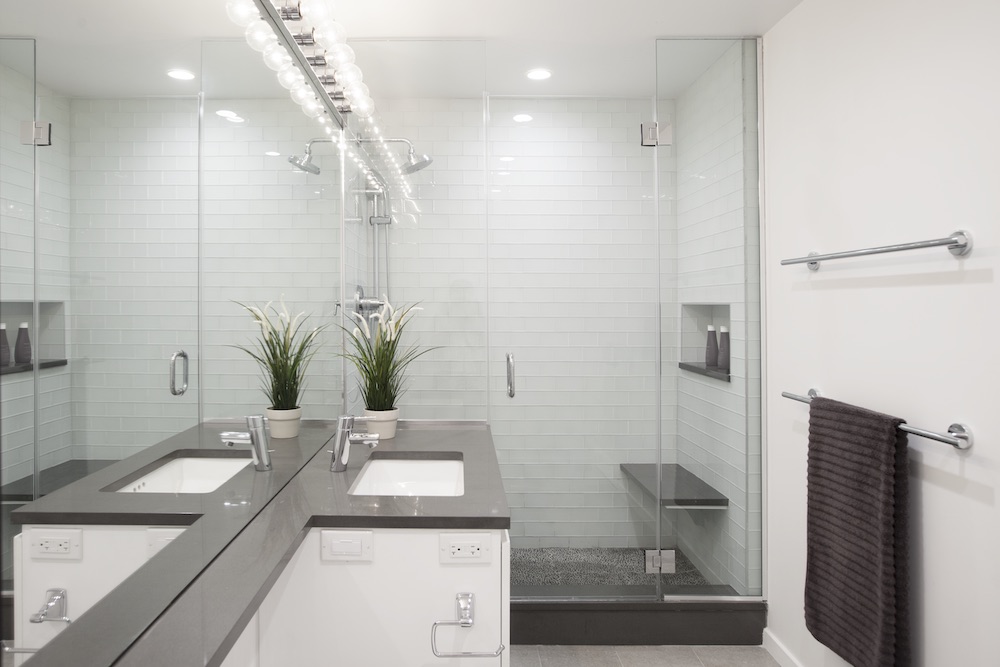
We keep coming back to quartz in bathrooms because it solves two needs at once. It has a crisp, tailored look, but it also stands up well to the messier parts of daily life around the sink.

Since it is non-porous and comes in a wide range of looks, quartz can feel quiet and minimal in one bathroom and more polished or stone-like in another.

A remodeled bathroom with a quartz counter, Calacatta porcelain shower wall tile, and black dot marble mosaic flooring
(Above) Sara’s remodeled bathroom with a quartz counter, Calacatta porcelain shower wall tile, and black dot marble mosaic flooring

Sara’s guest bathroom in Chelsea, New York City, shows how useful that flexibility can be. The homeowner built the room around a black-and-white palette and used a custom vanity with a white quartz counter, which helped brighten the space while keeping the overall look sharp. She also went with an offset sink, so one side of the counter stayed open for everyday use instead of getting swallowed up by the basin.

If you want quartz to feel more intentional in your own bathroom remodel, these ideas can help:

Renovate expertly with Sweeten

Sweeten brings homeowners an exceptional renovation experience by personally matching trusted general contractors to your project, while offering expert guidance and support—at no cost to you.

Start your renovation
  • Pair a light quartz top with darker cabinetry or black fixtures when you want the countertop to stand out a bit more.
  • Think about sink placement early, especially if you would rather have more open counter space beside the faucet.
  • Let the vanity do some of the visual work, whether that comes from color, texture, or smarter storage below.
  • Keep the surrounding finishes edited so the quartz has room to look clean and considered instead of getting lost in too many competing details.

3. Solid surface countertops make bathrooms feel seamless

A remodeled bathroom with a white solid surface vanity counter, white walls, and warm wood flooring
(Above) Mary’s remodeled bathroom with a white solid surface vanity counter, white walls, and warm wood flooring

Solid surface countertops, including Corian, tend to work best when you want the vanity to look smooth and visually quiet. Instead of relying on veining or pattern to make an impression, they create a cleaner line that can make the sink and counter read as one continuous piece.

That is a big reason they keep showing up in bathroom remodels, especially in smaller spaces where a simpler surface can help the room feel less busy.

A bathroom featuring a white Corian vanity countertop, white subway wall tile, and chrome fixtures
(Above) Celeste’s bathroom featuring a white Corian vanity countertop, white subway wall tile, and chrome fixtures

That approach comes through clearly in this bathroom in Park Slope, New York City. Celeste was drawn to Corian after seeing how seamless it looked in a friend’s bathroom, and that reference helped shape the design of her own vanity. The finished piece used a white Corian top with an integrated sink and side cutouts, which gave the vanity more dimension and made the countertop feel custom rather than standard.

Solid surface usually looks best when the rest of the vanity design supports it instead of competing with it. If you are thinking about using it in your own bathroom, these ideas can help:

  • Choose an integrated sink if you want the countertop to look smoother and more streamlined from end to end.
  • Pair it with wood cabinetry or another warmer finish so the bathroom does not start to feel too stark.
  • Keep the counter styling simple, since this bathroom countertop material tends to look strongest when its clean line stays visible.
  • Add personality through the vanity shape, hardware, or lighting, so the room still has depth even when the countertop itself is understated.

4. Wood countertops add warmth where bathrooms need it most

A renovated guest bathroom showcasing a wooden bathroom countertop with a white sink on top
(Above) Ylia’s renovated guest bathroom showcasing a wooden bathroom countertop with a white sink on top

Wood is not the most common choice for a bathroom countertop, which is exactly why it can feel so distinctive. In a room full of tile, stone, glass, and metal, a wood surface can bring in warmth and make the vanity feel more like a piece of furniture.

It usually works best for homeowners who like a softer, more layered look and do not mind giving the surface a little more care over time.

A bathroom renovation featuring a wooden counter with sink, bronze fixtures, and white Carrara marble wall tile
(Above) Karun’s bathroom renovation featuring a wooden counter with sink, bronze fixtures, and white Carrara marble wall tile

That sense of warmth comes through in this renovation in Windsor Terrace, Brooklyn. Karun used a vanity top made from a tree that had fallen in his sister’s backyard, which gave the bathroom a surface that felt both personal and custom. Against the cement walls, stone vessel sink, brushed bronze fixtures, and marble bathroom floor tile, the wood helped break up the harder finishes and made the room feel more grounded.

Wood can look especially good in a bathroom when you treat it as a contrast material, not just another countertop option. If you are considering it, these ideas can help:

  • Seal the surface well, especially around the sink and edges, so it is better protected from daily splashes.
  • Pair it with harder finishes like stone, tile, or metal to give the bathroom more balance.
  • Let the grain stay visible by keeping counter styling simple and avoiding too much clutter on top.
  • Use wood when the rest of the room leans cool or industrial, since it can soften the overall feel in a way other surfaces cannot.

5. Concrete countertops can make a bathroom feel built-in

A remodeled bathroom featuring a concrete vanity countertop, brass fixtures, and black wall tile
(Above) Nazli’s remodeled bathroom featuring a concrete vanity countertop, brass fixtures, and black wall tile

Concrete is often chosen when the goal is not softness or shine, but presence. On a vanity, it can give the bathroom a more architectural feel, especially when the rest of the room leans minimal or modern.

It also has a custom quality that appeals to homeowners who want something shaped for the space rather than picked off a shelf.

In Nazli and Larry’s bathroom renovation in Bedford-Stuyvesant, Brooklyn, that custom feel came through in a concrete-and-wood vanity and countertop designed to work with a wall-mounted faucet. Their architect prepared detailed drawings so the fabricators and carpenters could build the piece to fit the room. The long single-sink layout also left more counter space, while the teak veneer helped warm up the heavier look of the concrete.

If you are thinking of using concrete for your own remodel, these ideas can help:

  • Pair concrete with wood tones or warmer metal finishes so the vanity feels balanced instead of too stark.
  • Decide early whether you want a smoother, polished look or a more matte finish, then carry that choice through the tile, faucet, and vanity details.
  • Make sealing part of the plan from the start, since concrete needs that protection to hold up better in a bathroom.
  • Give the countertop enough uninterrupted space to show its texture and shape, especially if you want the vanity to feel more custom.

6. Granite countertops can ground a colorful bathroom

A renovated bath featuring a black granite counter, mint green bathtub, and mosaic stone flooring
(Above) A renovated bath featuring a black granite counter, mint green bathtub, and mosaic stone flooring

Granite never really falls out of the bathroom conversation because it brings a sense of weight and durability to the vanity. It can also add contrast in a way that feels more natural than flat black or plain white surfaces, especially when the stone has movement or flecks running through it. That makes granite a strong fit for bathrooms that already have personality and need a countertop that can hold everything together.

That balance shows up in this Jersey City bathroom remodel, where the homeowners were designing around a mint green bathtub they wanted to keep. They chose a larger vanity with drawers and a black granite top, which gave the room more storage while adding a darker note against the white wall tile and patterned stone floor. The vanity legs also helped the piece feel more like furniture, so the granite brought contrast without making the room feel too heavy.

These ideas can help if you’re considering granite in your bathroom:

  • Use granite when the bathroom already has color or pattern, since it can give the room a steadier base.
  • Pair a darker granite top with a vanity that has legs or some visual openness, so the whole piece does not feel bulky.
  • Repeat that darker tone somewhere else in the room, whether through trim, hardware, or grout, so the countertop feels intentional.
  • Choose a vanity with good storage underneath, because granite tends to look better when the counter itself can stay relatively clear.

Frequently asked questions

A good material for a bathroom countertop is marble if you want a timeless, polished look that can elevate the whole vanity. Quartz is also a great option if you want something that still looks refined but is easier to maintain day to day.

An affordable countertop material for a bathroom is solid surface. It can give you a clean, streamlined look and usually comes in at a lower price point than natural stone.

One of the most recommended bathroom countertop materials is quartz. It tends to be a favorite because it looks polished, holds up well around the sink, and requires little upkeep.

You may also like

Renovate with Sweeten!

sweeten-magic

We’ll match you with vetted general contractors and offer support until your project is done — at no cost to you!

Start your renovation

Customer review 5.0

sweeten-thumbsup

“Working with Sweeten was amazing, they matched me with amazing contractors and the work was done quickly. It was the easiest way to find quality contractors!”

— Tara G. from Brooklyn, NY

Read more reviews —>
Start your renovation
no-cost-blue

Subscribe to our
renovation newsletter